Low Light, High Ceilings: Hanging Paintings in a Victorian Hallway
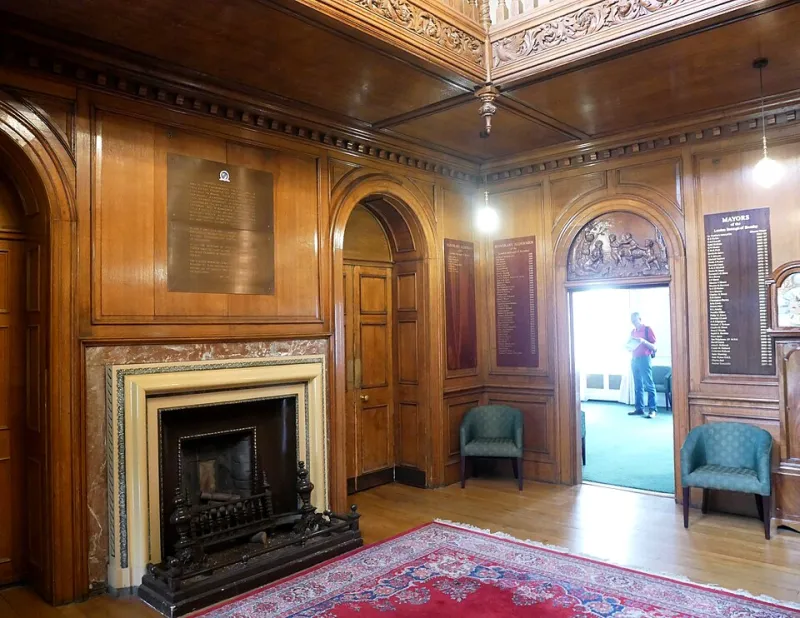
Photo: Doyle of London, CC BY-SA 4.0, via Wikimedia Commons
Victorian terraces are full of them: a hallway like a corridor, ceilings high enough for a church, light that arrives under the front door and then gives up. It is the last place people think of as a gallery, which is exactly why it works. A painting in a hallway is a small event you walk through twice a day. It does not have to behave like a museum piece.
I have been testing work in my own hall this autumn, moving the same three paintings between the end wall, the stretch above the radiator and the dark corner by the stairs. The lessons are not grand. They are practical, and they apply to most UK homes with narrow passages and very little natural light.
Start With the Wall You Actually Have
Measure the wall, not the painting. In a hallway, the usable space is usually narrower than it looks because of door swings, radiator valves, light switches and the shoulder-height reality of coats. I use brown paper templates taped to the wall for a week before I commit to a nail. It feels ridiculous. It saves holes.
The centre of the painting should generally sit around 145–150 cm from the floor, but in a tall Victorian hall that rule can make the art feel stranded. If the ceiling is high and the hallway is narrow, hang slightly higher than you would in a living room, then check it from the front door. You want it to meet you, not tower over you.
Also check the light at different times. A hallway that looks gloomy at noon can be almost bright at 4pm in November, and a painting that reads well in the morning can turn into a dark rectangle by evening. That is not a reason to give up. It is a reason to choose the work and the light together.
Scale: One Brave Piece Beats Seven Tiny Ones
Narrow hallways tempt people into clusters of small frames. Resist that if the wall is long and the light is poor. A row of tiny pictures becomes visual noise, and noise is not the same as interest. One larger painting, or two stacked vertically, gives the eye somewhere to land.
A tall, narrow work is your friend. I tested a 30 x 90 cm canvas in my own hall and it made the ceiling feel intentional rather than forgotten. A 60 x 80 cm piece on the end wall also works, provided the frame is shallow and you leave enough breathing room around it. If you are hanging above a radiator, leave at least 20 cm between the top of the radiator and the bottom of the frame; heat and constant dry air are not kind to paintings.
For a staircase wall, follow the angle of the stairs rather than fighting it. Two or three works stepped upward can look marvellous, but keep the gaps consistent. In a tight hallway, less really is more.
Frames: Keep It Slim, Warm and Shallow
A deep, ornate frame in a narrow hallway is a hazard and a visual bully. It catches shoulders, collects dust and makes the passage feel tighter. I favour low-profile frames, around 2 cm deep, in light oak, warm brass or an off-white finish. Black can disappear against dark skirting and dark doors; heavy gold can look theatrical in a space that is already dramatic enough.
If you are framing works on paper, ask for acrylic glazing rather than glass in a hallway. It is lighter and safer, and it will not shatter if someone knocks it with a bag. For oils and acrylics on board or canvas, skip the glass entirely. Let the surface breathe and let the picture light do the work.
Colour Temperature Is the Real Trick
A dark hallway does not need cold light. It needs warm light with a decent colour rendering index. I use 2700K–3000K LEDs for picture lighting, never the 4000K cool white that makes paintings look like office stationery. Look for CRI 90 or above if you can; it makes ochre, madder and storm grey behave themselves.
A simple picture light above the frame, angled slightly down, is often enough. Rechargeable versions are useful where there is no socket, and plug-in ones can go on a timer. Keep the light off the surface of the painting rather than blasting it straight on. If you are lighting a watercolour or a print, be careful about heat and direct sun; LEDs are safer than halogen, but no original needs a sunbeam aimed at it.
What to Hang When the Light Is Poor
Paintings with a clear internal light source hold up best. A pale harbour wall against a dark sea, a warm ochre field under a grey sky, a figure lit from one side: these read in shadow because the painting is doing some of the lighting work itself. Very dark, low-contrast pictures can vanish in a hallway, and pale watercolours behind glass can turn into a mirror.
Texture helps. Oils and acrylics with visible brushwork catch even a small amount of light and give the eye something to follow. I have also found that simple silhouettes and strong shapes work better than intricate detail in a passage you only glance through. You are not reading a novel; you are catching a sentence.
Test It Before You Drill
Live with the painting leaning against the wall for a few days. Move it from the end wall to the side wall. Look at it with the hall light on and off. Then commit. Victorian lath-and-plaster walls can be unforgiving, so use fixings rated for the weight and find a joist where you can. A lightweight canvas might hang on a removable hook, but an original painting deserves proper hardware.
A hallway is not a gallery. It is a transition, a draught, a place where coats live. That is exactly why a painting belongs there. It should surprise you on the way out and welcome you back in. Low light is not a problem to solve. It is a room with opinions, and the right painting can argue back.